

The following are a random selection of jokes and pictures, which some readers may find amusing. Or they may not. You have been warned. Some of them are also now available for purchase at cafepress, so if you want to, you can have these pictures on anything from a water bottle to a baby t-shirt to a cooking apron.
Some people say a joke's not funny if you have to explain it. Well, all of these jokes need explaining, as you'll see.
This one is a play on the German word for insect (Insekt) and on the German word for sparkling wine (Sekt). So the "Insekt" is "in Sekt".

What do you get if you cross a fried egg with a famous nursery rhyme? Fried egg, Fried egg, on the wall, who is the fairest of them all?
Explanation: in German, the famous quote from the evil queen in Snow White "Mirror mirror, on the wall" goes like "Spiegelein spiegelein an der Wand, ..." but a fried egg is called a "Spiegelei". So a simple removal of a consonant or two generates win.

This one shouldn't need too much explanation, it's simply a statement that the Santa at the back is more interesting. But it sounds more melodic and confusing in German: "der hintere Santa ist interessanter".
 (this design available at cafepress)
A triple bill this time, with tomatoes and vending machines. In the first panel, tomatoes (Tomaten). In the second panel, also tomatoes (auch Tomaten). In the third panel, vending machines (Automaten).

Another triple bill, this one with rows of herons. In the first panel, a heron (Reiher). In the second panel, two herons (2 Reiher). In the third panel, a row of herons (Reihe). Or Reiherreihe, if you prefer.
 (this design available at cafepress)
A simple one, playing on Germans' pronunciation of "Indiana Jones". Explanation: in German, "Indianer" means Indian, as in Native American. So the name of the character "Indiana Jones" sounds like "Jones the Indian".

German/English - This next one is a dual-language one, it makes sense in either English or German. If you say it in German, it says "that's stupid". If you say it in English, it says "that's blurred". Both are correct. Neat, huh?

German/French - This is another dual-language one, poking a little good-natured fun at the French accent when speaking German. So the word "Pech" in German sounds like the French word for peach. And the rest is just illustrating the difficulties of "h" and "ch" sounds.

There's a deliberately obscure phrase in German which got (somewhat) famous for being unintelligible when heard, and only understandable when seen written down. The nonsense question is "Mähen Äbte Heu?" (do abbots mow hay?). Of course they don't, noone mows hay, they mow grass, and anyway abbots have probably got lots of other things to do instead. So some possible answers are "Nein, Äbte mähen nie Heu, Äbte beten", or "Äbte mähen nie Heu". Of course it makes no sense, but the point is that for some reason these sounds and combinations just don't parse when you hear them for the first time, and it just sounds like a jumble of some foreign (probably asian) language. So typically even a German native language speaker will tell you that what you just said definitely isn't German.
 |
and the same again with a Swiss twist: |  |
| (this design available at cafepress) | (this design available at cafepress) |
This twist makes use of the Swiss informal greeting "hoi", which also sounds like "Heu". And abbots probably do prefer a more formal greeting than that, I imagine. This variation also doesn't sound German at all, if you aren't familiar with it. Except in this case, the text really isn't German, because "säget" (sagen) und "hoi" aren't really German words.
More of a silly cartoon than a joke, this one is just playing with the similar sounds of the German words "symmetrischer" (meaning symmetric) and "Mähdrescher" (meaning combine harvester). There's no double meaning here, but you might have to read it out loud to get it.

If you're looking for more graphical German jokes, check out the often hilarious series called Verwechslungsgefahr. Beware, there are hundreds of these little pics and many aren't funny but there are some gems in there (like Sandalen, Saunieren, ...).
I tried to suggest some more ideas to the author of these jokes by email, but I just got the error "mailbox full". So I'll have to just list them here instead:
Bäckerei (with picture of a bakery) - Becker Ei (with picture of Boris Becker's shorts)
Säule (with picture of big Roman column) - Säule (with picture of little piglet from Schwabenland)
Schicksal (some picture to illustrate fate) - Schicker Saal (with picture of posh dining hall)
Bissfest (meaning "al dente", maybe a nice crunchy apple) - Bissfest (meaning "bite party", like a vampire party)
Stuhlgang (a corridor with chairs in it) - Stuhlgang (a big elephant dropping)
Afterparty - no, on second thoughts, that's just horrible.
Star trek meets schwiizerdüütsch swearing. Explanation: the pictured character from Star Trek is called Uhura. In Swiss German, this sounds very much like the emphasising expletive for "very", and is often used in conjunction with the adjective "geil". Which also kind of fits the picture.

Newts (with an american accent) meet schwiizerdüütsch. Explanation: the word "newt" is sometimes pronounced as "noot" (rather than "nyoot"). In Swiss German, the word for "nothing" is "nüüt" (for "nichts"). So when the newt is missing, there's nüüt! (Note, this is heavily influenced by Simon Drew's Puffin, Nuffin print)
 (this design available at cafepress)
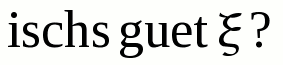
What they almost always ask you after a meal in a swiss restaurant: (it helps if you know your Greek letters too): (Explanation: "isch es guet gsi?" means "was it good?", and the greek letter is "xi" which is pronounced the same as "gsi". Sometimes. Unless it's pronounced "xseye", in which case this doesn't work so well)
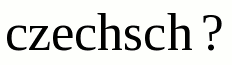
What a Swiss person might ask you to see whether you understand or not.
Explanation: "checken" means to understand, so "checksch es?" asks whether you get it. But that's so close to "czech" that it had to be combined, especially when the result is such a mash of consonants.
Here is a conversation in a doctor's surgery, which for reasons which will become evident, only works in written form, not when read out :)
Doctor, doctor, I've got a pain.
OK, could you tell me where it is?
I left it at home.
Ummm, so can you describe the pain for me?
Well, it's not very big, and it's brown, and it smells really good.
And does it hurt?
No of course it doesn't hurt, it's a pain au chocolat!
<facepalm>
Here's a tricky one - a play on the double-meaning of "pipe". You have to be a bit of a geek (maybe even a unix geek) to get this one.
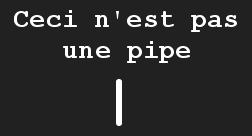
Explanation: this is based on the famous Magritte painting with the same caption, only this turns it around to refer to the unix pipe "|".
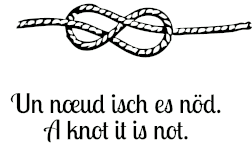
And inexplicably following the same theme even further, and extending the meta-ness, some digital logic and some rope:
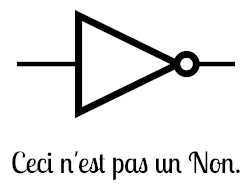
For variety, a simple text-only one, for geeks. This is probably already a t-shirt somewhere:
And finally a not-so-tricky one. Every geek should know the difference between vecta graphics and rasta graphics, right? Well just in case you're not so familiar with PNG and SVG, here's an illustration of the major differences:
 (this design available at cafepress)
